Barena honey from the Venice lagoon
Barena honey · Miele Millefiori di Barena · Lio Piccolo · Cavallino-Treporti · Venice Lagoon
Barena honey of the Venice lagoon: a monofloral sea lavender honey from the summer bloom of the barene of Lio Piccolo, in Cavallino-Treporti, in the heart of the northern lagoon. Beside it, Miele Millefiori di Barena, the wildflower honey that follows the sea lavender and carries on until autumn.
Slow Food Presidium · Miele delle barene della Laguna veneta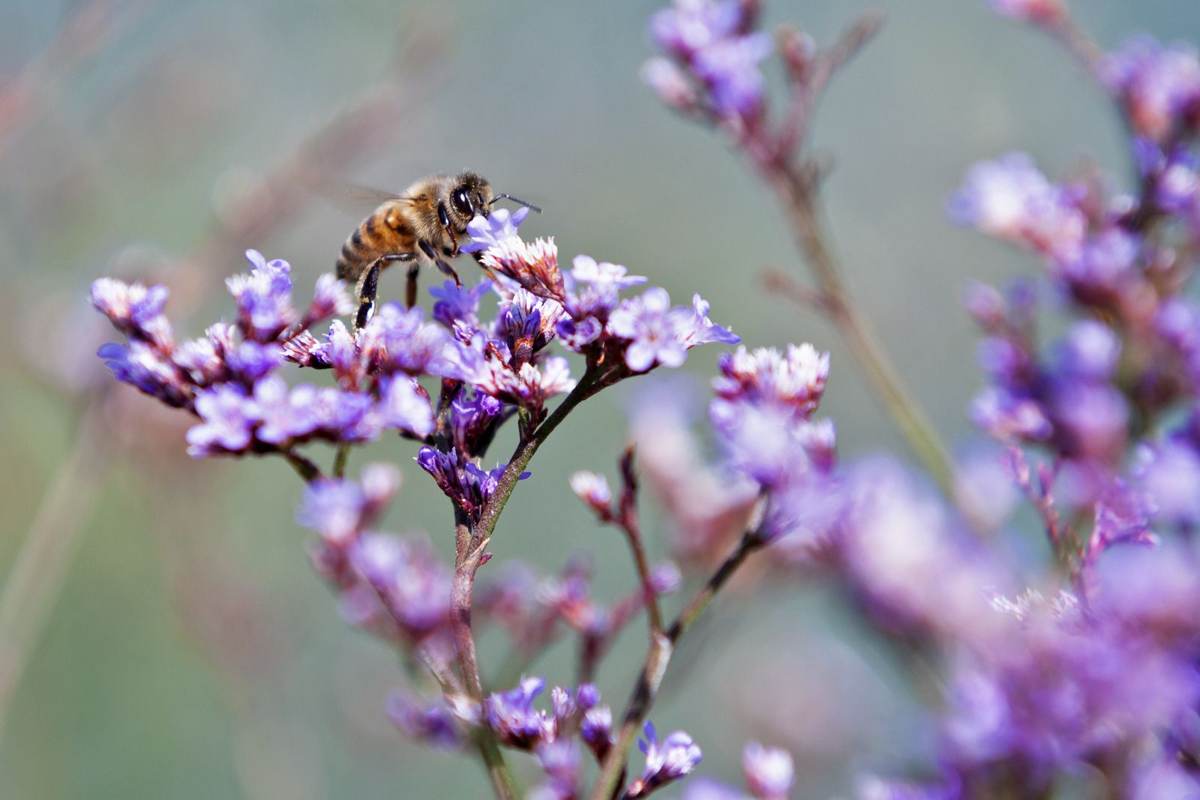
How to buy
- Two barena honeys: Miele di Barena, a monofloral sea lavender honey, and Miele Millefiori di Barena, which gathers the other blooms.
- They are seasonal honeys: quantities change from year to year, and Miele di Barena arrives only when the bloom allows it.
- Over time they crystallise: it is in their nature. Enjoy them by the spoonful, on bread and in the kitchen, as a finishing touch.
Where to buy: at the apiary in Saccagnana, or at your home with shipping. Miele di Barena: 125 g €8, 400 g €22. Miele Millefiori di Barena: 125 g €7, 400 g €16. Write to us or see the Contact and visits page: we will tell you how to collect or receive them.
Miele di Barena
Monofloral sea lavender honey
It comes from the sea lavender bloom, the «fiorella di barena», which flowers from June to September on the barene of Lio Piccolo, peaking from mid-June to mid-August. Rare and precious, a small miracle of the lagoon that is not granted to us every year.
- Colour
- Dark, with reddish reflections.
- Taste
- Slightly bitter, with a salty aftertaste and mineral notes.
- Texture
- Crystallises quickly, with a fine grain, especially in small jars.
Miele Millefiori di Barena
Honey of the barene of the Venice lagoon
It begins where the sea lavender ends and carries on until autumn, gathering one after another the blooms of the barena: sea aster, glasswort and the other plants that live in salt, then Jerusalem artichoke and ivy, with a small part of the last sea lavender. The result is a honey that carries the aromas of the whole lagoon.
- Taste
- Dark and decisive, with a salty finish.
- Texture
- Crystallises over time.
For those who want to know more
Beyond the honey itself, we tell you where it comes from: the barene, our bees, and their story, through to the Slow Food Presidium. If you’ve already chosen your jar, feel free to stop here — read on if you’d like to know more.
What are the barene
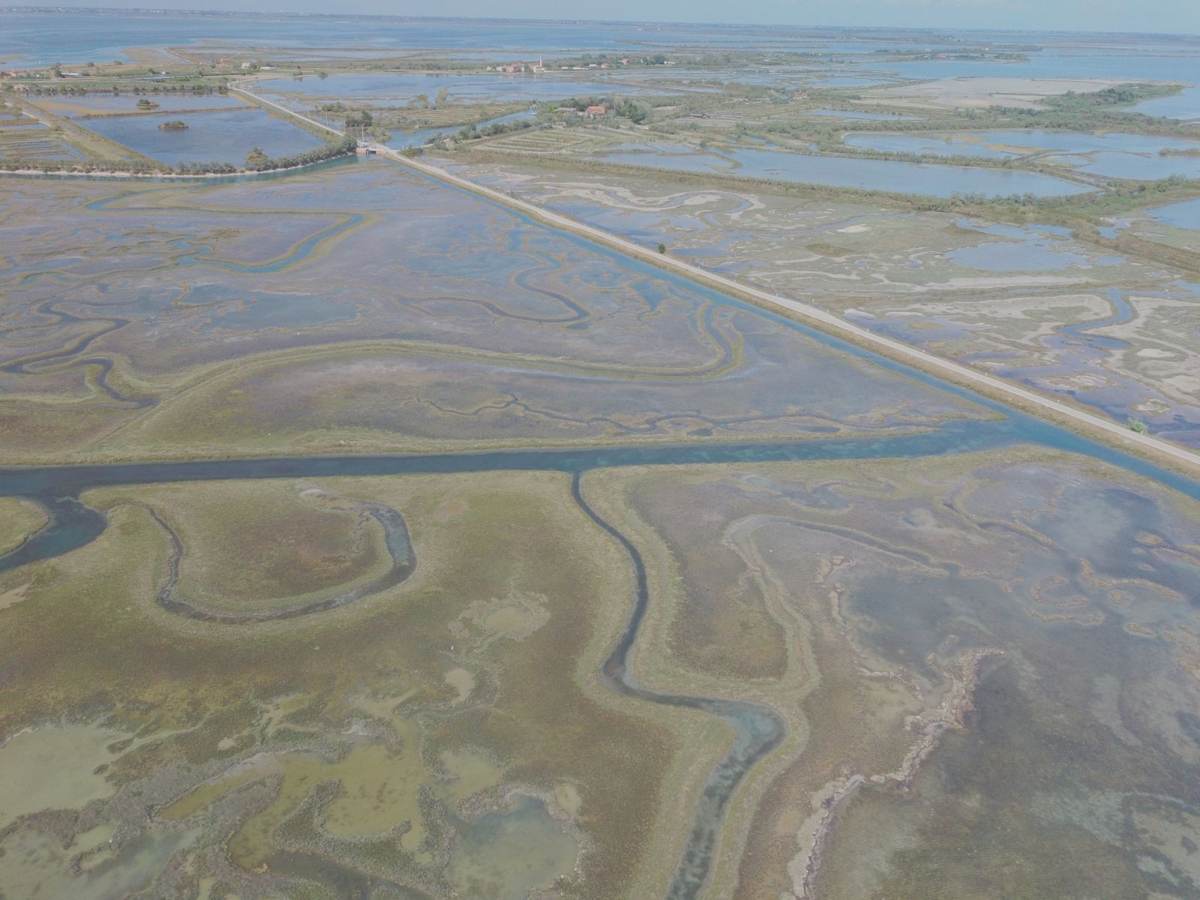
The barene are low lands of clay and sand, rising only a few tens of centimetres above sea level and almost entirely submerged by high tides. They are the most fragile and most alive part of the Venice Lagoon. “Barena” names the place, not the flower: so, in front of a jar, what matters is asking which flowers the honey comes from.
The barene are also the lands where the history of Venice begins. With the fall of the Roman Empire and the invasions, the people of the mainland, from Altino to Aquileia, sought refuge in the lagoon, among islets and low lands like these, which they consolidated with piles and reclamation. Torcello, in the northern lagoon, stands at the centre of a barena area, and the diocese of Altino moved to Torcello. From those lagoon settlements, over the centuries, the Republic of Venice was born.
From April to the end of September the barene are covered with plants that can live in salt:
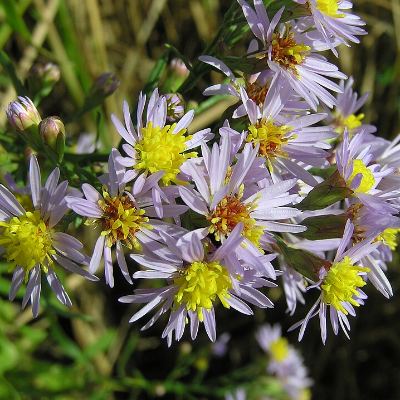 Sea asterTripolium pannonicum
A small daisy with lilac petals and a yellow heart. Fleshy leaves, it blooms from late summer to autumn.
 Golden samphireInula crithmoides
A low shrub with narrow, fleshy leaves. In summer it is covered with small yellow flowers.
 GlasswortSalicornia europaea
Green, fleshy, segmented stems, red in autumn. It is edible: the asparagus of the sea.
 Sea bliteSuaeda maritima
A low plant with small cylindrical fleshy leaves, green and then reddish.
 TamariskTamarix gallica
A shrub of the embankments, with feathery twigs and pink spikes. It tolerates salt well.
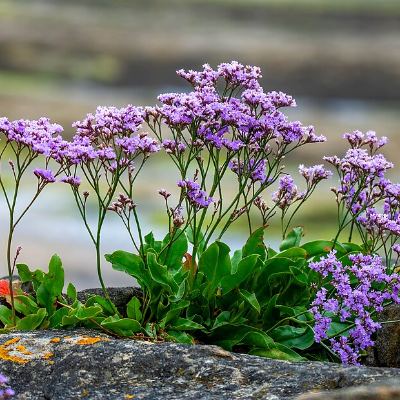 Sea lavenderLimonium vulgare
Dense branches of small violet flowers that colour the barene in summer. This is where our Miele di Barena comes from.
Flower photos from Wikimedia Commons, cropped: Sea lavender – peterichman (CC BY-SA 2.0); Sea aster – Le.Loup.Gris (CC BY-SA 3.0); Golden samphire – Chilepine (public domain); Glasswort – Robert Flogaus-Faust (CC BY 4.0); Sea blite – Robert Flogaus-Faust (CC BY 4.0); Tamarisk – Christian Ferrer (CC BY 4.0).
Why the barene give these two honeys
They protect Venice. At high tide they flood and take in the water like an expansion basin; at low tide they slowly give it back to the lagoon. They break the waves and hold the lagoon floor together: without barene the lagoon would become open sea.
They capture CO₂. According to a University of Padua study, every square kilometre of barena holds about 17,000 tonnes of carbon and stores another 85 every year.
Sea lavender plays its part. Underground it grows up to 12 times the mass you see on the surface: dense roots that hold the barena in place and enrich the mud with carbon (University of Padua). In its roots it also traps some pollutants from the sediments, and for this reason it is studied at Ca’ Foscari to help clean up contaminated soils.
They are increasingly rare. River sediments are missing, boat traffic creates wave motion that erodes them, the sea rises and the ground sinks; in summer, evaporation also raises the salinity, and not all plants can bear it. Sea lavender suffers too: between heat, drought and out-of-season frosts, blooms are scarcer and more irregular than they used to be. In a century the lagoon has lost more than two thirds of its barene:
Our bees and the fiorella di barena
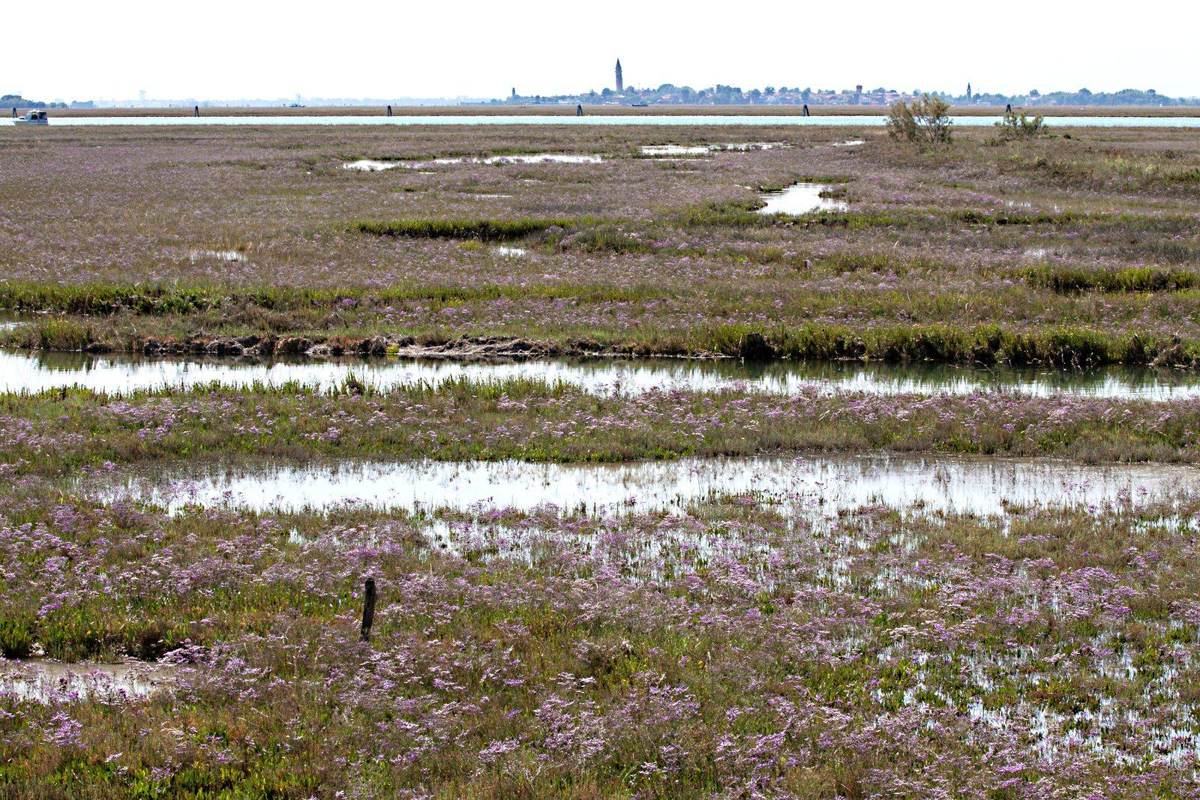
In summer the barene turn violet: the sea lavender flowers, the first bloom of the season. Others follow, and the nectars end up mixing. To obtain a monofloral sea lavender honey you must catch the bloom at its fullest and close the harvest at the right moment: afterwards, the bees make Miele Millefiori di Barena, in the months that follow. It is a matter of timing, and the quantity changes every year.
Why Lio Piccolo
Arriving in Cavallino-Treporti was a choice. We were looking for wide, quiet barene, far from boat and car traffic, with stretches of sea lavender large enough to feed the bees. At Lio Piccolo we found them.
Lio Piccolo is a thin strip of land in the heart of the northern lagoon, home to very few people and left almost entirely to nature and to those who look after it. Already in Roman times the lagoon here provided fish, salt and oysters: recent excavations by Ca’ Foscari University have uncovered the remains of a 1st-century AD residence. Today it is a landscape of vegetable gardens, channels, fishing valleys and barene, where castraure, the first buds of the violet artichoke, a Slow Food Presidium, are grown.
Our apiaries at Lio Piccolo are in a fishing valley: an area of channels, with spontaneous native vegetation and barene where vallicoltura, the traditional lagoon fish farming, is practised.
It is also one of the places most loved by birdwatchers: among the barene and ponds you can see herons, little egrets, cormorants, black-winged stilts, avocets and terns, and in winter pink flamingos, which find here one of their wintering places.
Lio Piccolo is happily reached by bicycle, from Ca’ Savio and Treporti, among fishing valleys and barene. The route is described on the Contact page.
Bees that live in the lagoon
It is not a matter of “preparing” the bees for the bloom: we work together with them, matching their needs with ours, in a coexistence made of observation, timing and daily choices. Difficulties are not lacking: heat, excessive rain, storm surges and strong winds that tire the bees on their way back from foraging. For this reason Miele di Barena is not an always-available monofloral honey: if the bloom is not favourable, in that year it is not produced.
Here the bees stay all year: generation after generation they have adapted to the salty air, the wind and the calendar of the barena blooms.
Research confirms it. In a large European study, covering over 600 colonies in 11 countries, local bees survived on average 83 days longer than those brought in from elsewhere. And in the Landes, in France, local bees have a brood rhythm that follows the blooms of their area: an inherited trait, which queens pass on to new colonies.

Miele Millefiori di Barena
When the sea lavender fades, the barena does not stop: the bloom goes on, and with it the bees’ work. Through the whole season that follows they gather what the lagoon offers, one bloom after another: sea aster, glasswort and the other plants that live in salt, then Jerusalem artichoke and ivy, with a small part of the last sea lavender.
From this comes Miele Millefiori di Barena, the honey of the barene of the Venice lagoon: dark and decisive, with a salty finish, which crystallises over time. It changes from one year to the next, because blooms, wind and tides are never the same, but it always keeps the character of the barena.
It is a honey of its own, with its own story, and it is part, like Miele di Barena, of the Slow Food Presidium. For those approaching barena honeys it is an excellent starting point; those who love the character of the lagoon can then discover the monofloral sea lavender honey.
Slow Food Presidium
Slow Food defends food that is good, clean and fair: good to eat, clean for the environment, fair to those who produce it. With its Presidia it supports small producers who save products at risk of disappearing.
We are among the producers of the Slow Food Presidium Miele delle barene della Laguna veneta (honey of the barene of the Venetian lagoon), which brings together beekeepers from different lagoon and coastal areas, with two of our honeys: Miele di Barena and Miele Millefiori di Barena. The Presidium was presented in Turin, at Terra Madre Salone del Gusto 2026. Barena honey is also in the Ark of Taste, the catalogue of flavours to be saved.
Where it is produced
The Presidium area covers the coastal territory and lagoon areas of the Metropolitan City of Venice and the provinces of Padua and Rovigo. Our apiary is in Cavallino-Treporti, in the Venice lagoon, between Saccagnana and Lio Piccolo: our bees never leave it.
The honeys of the Presidium
The Presidium brings together different honeys, united by their origin: the barene of the Venetian lagoon.
- Wildflower honey of the barene: the most common type, which gathers the blooms of the barena. Ours is Miele Millefiori di Barena, which takes the baton from the sea lavender.
- Monofloral honeys: rarer, above all sea lavender. Ours is Miele di Barena.
We make two: Miele di Barena, a monofloral sea lavender honey, and Miele Millefiori di Barena. Two honeys, different in character and season, both of the Presidium.
In the kitchen
Miele di Barena has an unusual character: sweet at first, then salty, balsamic, with a bitter finish. For this reason it gives its best in savoury dishes, where it works as a counterpoint, more than in sweet ones. Miele Millefiori di Barena also works with the same dishes, with a different character: try both to taste the difference.
Ideas to try
Honey is added at the end, off the heat, as a glaze or a raw drizzle: cooking would change its character.
- Sarde in saor: a teaspoon off the heat on the cooked onions, to soften the acidity of the vinegar.
- Cheese: drizzled over fresh ricotta, goat cheeses and young cheeses; with an aged pecorino or a blue cheese, alongside walnuts and toasted bread.
- Shellfish and fish: a drop, raw, on just-seared prawns or scallops, at the end of cooking.
- Oven-roasted or grilled vegetables: carrots, pumpkin, radicchio, artichokes: a thread of honey on the plate just off the heat, to underline the bitterness.
- White meats and pork: at the end of cooking, off the heat, on the still-hot roast.
- Simple desserts: Greek yoghurt, panna cotta, cream ice cream with a few flakes of salt.
Frequently asked questions
Why has my Miele di Barena turned solid?
It is normal and not a defect: sea lavender nectar is rich in glucose, which tends to crystallise early, forming fine crystals. The honey is the same, just more compact: it is eaten like this, by the spoonful.
What is the difference between Miele di Barena and Miele Millefiori di Barena?
They come from the same barena, but at different times. Miele di Barena is the monofloral sea lavender honey: the harvest closes at the peak of the summer bloom. Miele Millefiori di Barena begins where the sea lavender ends and gathers the blooms that follow, among the native plants of the lagoon edge. They have their own stories and flavours.
What does “barena honey” mean?
The barena is a low land that the tide covers and uncovers. Different honeys can come from there, wildflower or monofloral. Our Miele di Barena is monofloral sea lavender; Miele Millefiori di Barena gathers the blooms that follow.
Where can I buy Miele di Barena and Miele Millefiori di Barena?
At the apiary in Saccagnana, or at your home with shipping. Days, seasons and appointments are on the Contact page.
What is the fiorella di barena?
It is the name by which sea lavender (Limonium vulgare) is known in the lagoon: a plant with small violet flowers that colours the barene in summer. Our Miele di Barena comes from its nectar.
Why is it salty?
Sea lavender grows on ground bathed by the salt water of the tide, and the honey carries its character. You find it again, with a different note, in Miele Millefiori di Barena, born among plants that live in salt.
Do your bees move?
No. Ours is a stationary apiary: the bees stay in the lagoon all year. Details are in the «Bees that live in the lagoon» section.
Where to find us. At Saccagnana, along the road to Lio Piccolo. Out of season, with the bees at rest, we arrange a visit in advance: write to us. Details on the Contact and visits page.